Levels of malondialdehy and conjugated dienes in liver of rats with experimental metabolic syndrome
Keywords:
Metabolic syndrome, MDA, conjugated dienes, liverAbstract
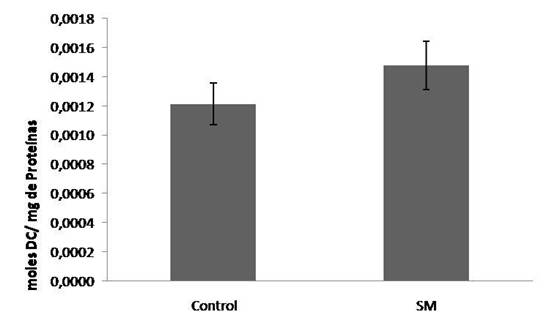
Metabolic syndrome (MS) is a cluster of metabolic abnormalities, which presents with hepatosteatosis associated with hepatic oxidative stress. In this study, hepatic level of conjugated dienes (DC) and malondialdehyde (MDA) in experimental SM were determinated. Adult male Sprague Dawley rats were used and induction of SM was performed with 10% fructose in drinking water for 15 days, at the end of this time Fasting blood sample was obtained to determine blood chemistries (glucose, triglycerides and cholesterol) by commercial kits and insulin by competitive ELISA. Liver samples were homogenized to quantify levels of DC (isopropanol extraction) and MDA (TBARS). The SM group showed elevated levels of glucose, triglycerides, cholesterol and insulin significantly (p≤0,05) relative to the control group. As regard the levels of liver DC a slight increase in the group with MS (0.0014 ± 0.00016 mol / mg PT) when compared with the control group (0.0012 ± 0.00014 mol / PT mg) was observed without reaching significant difference, meanwhile MDA levels of the control group (1.8 ± 0.15 nmol / mg PT) has higher levels than the animals with SM (1.5 ± 0.08 nmol / mg PT) no significant differences (p≤0,05). Conclusion: Fructose was effective to induce SM. The levels of DC and MDA are not high, which could be related to the ability of cells to activate antioxidant mechanisms (Mn-SOD and NADPH) in presence of free radicals within 15 days of SM induction.
Downloads
Published
Issue
Section
License
Gaceta de Ciencias Veterinarias se apega al modelo Open Access, por ello no se exige suscripción, registro o tarifa de acceso a los usuarios o instituciones. Los usuarios pueden leer, descargar, copiar, distribuir, imprimir y compartir los textos completos inmediatamente después de publicados, se exige no hacer uso comercial de las publicaciones. Para la reproducción parcial o total de los trabajos o contenidos publicados, se exige reconocer los derechos intelectuales de los autores y además, hacer referencia a esta revista. La publicación de artículos se hace sin cargo para los autores. Los trabajos pueden consultarse y descargarse libremente, y de manera gratuita, en extenso en versión digital, desde su enlace Web institucional. Los textos publicados son propiedad intelectual de sus autores. Las ideas, opiniones y conceptos expuestos en los trabajos publicados en la revista representan la opinión de sus autores, por lo tanto, son estos los responsables exclusivos de los mismos.