
Correlation between the dynamic cone penetrometer and the California support relationship in the field for the sub-rasant floor of the Portoviejo-Manta road
DOI:
https://doi.org/10.13140/RG.2.2.12491.54569Keywords:
dynamic cone penetrometer, DCP, California support relationship, CBRAbstract
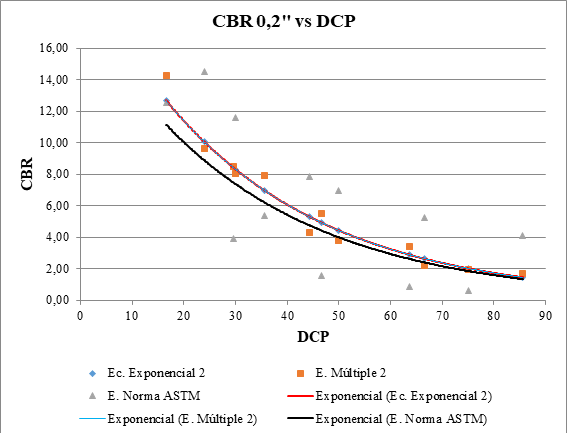
The Portoviejo – Manta road is a main land communication artery in the province of Manabí in Ecuador, a fundamental axis in the country's economic, social and tourism development. The decentralized autonomous government of the province of Manabí based on studies proposes an extension of the four existing lanes to six; for this, a comprehensive analysis involving a traffic, geological and geotechnical study is important. Given that this province at superficial levels presents a uniform clay formation, the present investigation evaluates the conditions of the track support terrain, proposing two dynamic cone penetrometer methods and the California support ratio, examining at the same time if the correlation between them exists. Standardized field and laboratory work was carried out over a length of 35 kilometers with paired tests every 500,00 m. The data obtained from the field and laboratory were processed and analyzed using statistical linear regression methods, validated through hypothesis testing and significance of the p-value. At first, a direct correlation was obtained between both methods and an equation with a correlation value of 0,80, with a significance of 7,246x10-5. A second multiple regression equation was carried out in which correlation values were obtained between the methods, plus the physical parameters of the soil of 0,82 and its corresponding p-value of 0,0091, thus validating the reliability of the results.
Downloads
Published
Issue
Section
License
The opinions expressed by the authors do not necessarily reflect the position of the editor of the publication or UCLA. The total or partial reproduction of the texts published here is authorized, provided that the complete source and electronic address of this journal is cited. Authors have the right to use their articles for any purpose as long as it is done nonprofit. The authors can post on the internet or any other media the final approved version of their work.