
Sensitivity analysis of the hydrological and hydraulic parameters of the SWMM model and its application in urban drainage systems
DOI:
https://doi.org/10.13140/RG.2.2.26994.66248Keywords:
urban drainage, SWMM, hydrological parameters, hydraulic parametersAbstract
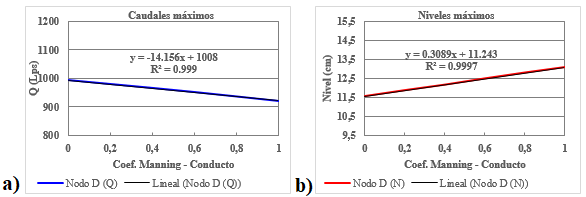
Simulation models are widely used for the design and management of urban drainage systems, such as the SWMM Stormwater Management Model. However, the quality of its results is directly related to the quality of the data provided, since an incorrect estimate of these may lead to a different behavior than expected in the real case. There is uncertainty in many hydrological and hydraulic input parameters of the model, since most of them are estimated and there are no measured data to calibrate it. In this work a sensitivity analysis is carried out to various parameters to detect the most influential in the simulation of urban drainage systems. It consisted of locally varying each of the parameters and assessing their influence on the variation of the flows and maximum levels at a point in the Copacoa Urbanization, Palavecino municipality of the Lara State, Venezuela. From the results obtained, it is concluded that for simulations of urban watersheds where impervious areas predominate, the least sensitive method for the generation of the rain hietrogram is that of alternate blocks, while the one with the greatest variability is the triangular hietrogram. Regarding the basin component, the most sensitive parameters are the percentage of impermeable area, the slope of the basin and the Manning coefficient assigned to the impermeable area. In relation to the duct, the Manning coefficient parameter also presented an appreciable sensitivity, but of a lesser magnitude compared to those obtained for the basin component.
Downloads
Published
Issue
Section
License
The opinions expressed by the authors do not necessarily reflect the position of the editor of the publication or UCLA. The total or partial reproduction of the texts published here is authorized, provided that the complete source and electronic address of this journal is cited. Authors have the right to use their articles for any purpose as long as it is done nonprofit. The authors can post on the internet or any other media the final approved version of their work.