
Analysis of traffic congestion for the improvement of a main road in Guayaquil-Ecuador
DOI:
https://doi.org/10.13140/RG.2.2.21905.04960Keywords:
traffic congestion, vehicular traffic control, traffic signsAbstract
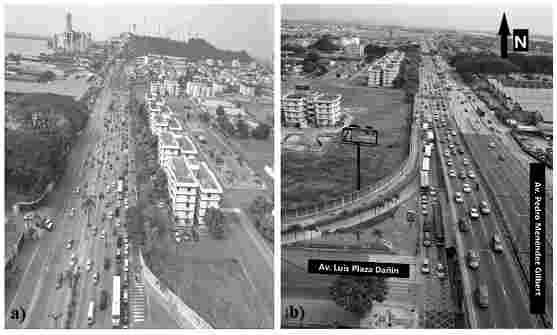
In Guayaquil-Ecuador, Av. Pedro Menéndez Gilbert is a main road with a designed capacity of 9000 vehicles/h, currently presenting traffic congestion problems, which affects its users. In order to propose possible solutions to the mobility problem, the research carried out aimed to analyze alternatives that would improve the level of service. The data collection method consisted of observation, with fieldwork at the entrance and exit intersections of a 900-m-long section. Manual counts and vehicle categorization were carried out for one week, as well as counting the distribution times of the traffic lights. The intersections were characterized in their geometry, traffic flows and traffic light system. Based on a previous study, a 5-year increase from 135,170 vehicles to 190,424 vehicles was projected. It was found that the main causes of congestion are the distribution of the alternating times of the signal cycle, and the blockage that occurs by the Metrovía feeder and collector buses. It is concluded that the main solution is the updating and proper adjustment of the traffic light system, as well as the opening of a pre-existing exit road, prior to the intersection, and control of the blockage produced by the Metrovía units
Downloads
Published
Issue
Section
License
The opinions expressed by the authors do not necessarily reflect the position of the editor of the publication or UCLA. The total or partial reproduction of the texts published here is authorized, provided that the complete source and electronic address of this journal is cited. Authors have the right to use their articles for any purpose as long as it is done nonprofit. The authors can post on the internet or any other media the final approved version of their work.