Determination of total phenol derivatives obtained from lignin black liquor as alternative to production
Keywords:
Lignin, waste, precipitation, phenols, antioxidantsAbstract
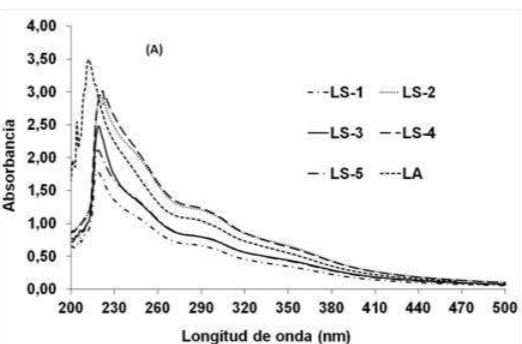
Lignin is an industrial waste being worthless in papermaking byproduct of black liquor obtained from the pulping process in some Venezuelan plants. The black liquor is obtained from the Kraft pulping process to extract lignin sulphite by acid precipitation and quantify the amount of total phenols in such lignin products used in this study. Spectrophotometry Molecular absorption in the UV-Visible and Infrared Spectroscopy (FTIR) region were used to carry out these study techniques. The products obtained in the study had the same signs than commercial lignin (LA), along with the extracted lignin present little degradation HCl, confirmed by infrared spectra. Also, the amount of total phenols was quantified in derivative lignin obtained using the Folin-Ciocalteu. In the sulphite process extracted lignin with acetic acid derivative contains more phenols, and in the Kraft process, the derivative lignin extracted with fewer nitric acid present. The amount of total phenolics present in these derivatives are good for making antiseptics, detergents, nylon, resin and many industrial products.
, , , ,
Lignin, waste, precipitation, phenols, antioxidants
Downloads
References
Calvo, J. (2014). Pinturas y barnices: Tecnología básica. Madrid. Díaz de Santos. Pp.133.
Casey, J. (1990). Pulpa y papel. México, D. F.: Editorial Limusa. Vol. 1, pp. 71–150, 358-602.
Chakar, F. y Raguaskas, S. (2004). Review of current and future softwood kraft lignin process chemistry. Industrial Crops and Products. Vol. 20, pp. 131-141.
Changqing, J., Christensen, P., Egerton, T., Lawson, E. y White, J. (2006). Rapid measurement of polymer photo-degradation by FTIR spectrometry of evolved carbon dioxide. Polymer Degradation and Stability. Vol. 91, pp. 1086-1096.
García, C. (2015). Control de Calidad del Ácido Salicílico en un polvo farmacéutico. Universidad Técnica de Machala, Facultad de Ciencias Químicas y de la Salud, pp. 6.
González, A. (2007). Caracterización de Fracciones de Lignina Extraídas del Licor Negro con Solventes Orgánicos. Revista Forestal Latinoamericana. N° 42, pp. 51-64.
Grabber, J. (2005). How do lignin composition, structure, and cross-linking affect degradability? A review of cell wall model studies. Crop Science. Vol. 45, pp. 820-831.
Hatfield, R. y Fukusima, R. (2005). Can Lignin Be Accurately Measured? Crop Science. Vol. 45, pp. 45, pp. 832-839.
Hüttermann, A., Mai, C. y Kharazipour, A. (2001). Modification of lignin for the production of new compounded materials. Applied Microbiology and Biotechnology. Vol. 55, Nro 4, pp. 387-394.
Ikawa, M., Schaper, T., Dollard, C. y Sasner, J. (2003). Utilization of Folin-Ciocalteu phenol reagent for the detection of certain nitrogen compounds. Journal of Agricultural and Food Chemistry. Vol. 51, Nro 7, pp 1811–1815.
Kirk, K. y Obst, J. (1988). Lignin Determination. Methods in Enzymology. Academic Press, Inc. Vol. 161, pp. 87–101.
Liesa, F. y Bilurbina, L. (1990). Adhesivos industriales. Barcelona, Editorial Marcombo. Vol. 39, pp. 42.
Lorenzo, P., Moreno, A., Lizasoain, I., Leza, J., Moro, A. y Portolés, A. (2008). Velázquez. Farmacología básica y clínica. Décimo octava edición, Buenos Aires, Médica Panamericana. Pp. 145.
Micheli, F. (2006). Enfermedad de Parkinson y trastornos relacionados. Segunda edición. Buenos Aires, Médica Panamericana. Pp. 214.
Morrison, W., Himmelsbach, D., Akin, D. y Evans J. (2003). Chemical and Spectroscopic Analysis of Lignin in Isolated Flax Fibers. Journal of Agricultural and Food Chemistry. Vol. 51, Nro 9, pp. 2565–2668.
Nagarathnamma, R. y Bajpai, P. (1999). Studies on decolourization, degradation and detoxification of chlorinated lignin compounds in kraftbleaching effluents by Ceriporiopsis subvermispora. Process Biochem. Vol. 34, Nro 9, pp. 34, 939–948.
Padilla, A. y Rincón, L. (2008). Contenido de polifenoles y actividad antioxidante de varias semillas y nueces. Órgano Oficial de la Sociedad Latinoamericana de Nutrición. Vol. 58, Nro 3, pp. 303-308.
Peck, V. y Daley, R. (1994). Toward a “Greener” Pulp and Paper Industry. The Search for Mill Effluent Contaminants and Pollution Prevention Technology. Environmental Science & Technology. Vol. 28, Nro 12, pp. 524-527.
Piña, I., Ysambertt, F., Arias, M., Chirinos, J. y Castillo, M. (2011). Capacidad antioxidante de la lignina extraída del licor negro en polietileno de baja densidad. Revista iberoamericana de polímeros. Vol. 12, Nro 4, pp. 216-226.
Pouteaua, C., Dolea, P., Cathalaa, B., Kurek, B. y Monties, B. (2005). Structural modification of Kraft lignin after acid treatment: Characterization of the apolar extracts and influences on the antioxidant properties in polypropylene. Industrial Crops and Products. Vol. 21, pp. 101–108.
Redolar, D., Moreno, A., Robles, N., Soriano, C., Torras, M. y Vale, A. (2010). Fundamentos de Psicobiologia. Primera edición en lengua castellana, Barcelona, UOC. Pp. 239- 240.
Rossi, C., Pereyra, A., González, G., De León, M. y Chagra, P. (2008) .Composición química, contenido de polifenoles totales y valor nutritivo en especies de ramoneo del sistema silvopastoril del Chaco árido argentino. Zootecnia Tropical. Vol. 26, Nro 2, pp. 105-115.
Toledano, A., Serrano, L., Garcia, A., Mondragon, J. y Labidi, I. (2010). Comparative study of lignin fractionation by ultrafiltration and selective precipitation, Chemical Engineering Journal. Vol. 157, Nro 1, pp. 157, 93–99.
Vinson, J., Zubik, L., Bose, P., Samman, N. y Proch, J. (2005). Dried fruits: excellent in vitro and in vivo antioxidants. Journal of the American College of Nutrition. Vol. 24, pp. 44–50.
Yang, R. y Ragauskas, A. (2002). Oxygen Degradation and Spectroscopic Characterization of Hardwood Kraft Lignin. Journal of Industrial & Engineering Chemistry. Vol. 41, Nro 24, pp. 5941-5948.
Ysambertt, F., González, T., Delgado, N., Bravo, B., Chávez, G., Cáceres, A., Márquez, N. y Bullón, J. (2009). Propiedades tensoactivas de la lignina extraída del licor negro modificada por reacciones asistidas por microondas. Revista Cubana de Química. Vol. 21, Nro 3, pp. 66.
Downloads
Published
Issue
Section
License
The opinions expressed by the authors do not necessarily reflect the position of the publisher of the publication or of UCLA. The total or partial reproduction of the texts published here is authorized, as long as the complete source and the electronic address of this journal are cited.
The authors fully retain the rights to their works, giving the journal the right to be the first publication where the article is presented. The authors have the right to use their articles for any purpose as long as it is done for non-profit. Authors are recommended to disseminate their articles in the final version, after publication in this journal, in the electronic media of the institutions to which they are affiliated or personal digital media.