Neural Networks in the prediction of microclimate, La Hechicera-Mérida-Venezuela, Case of Study
Keywords:
microclimate, neuronal network, microclimate prediction, climatic predictionAbstract
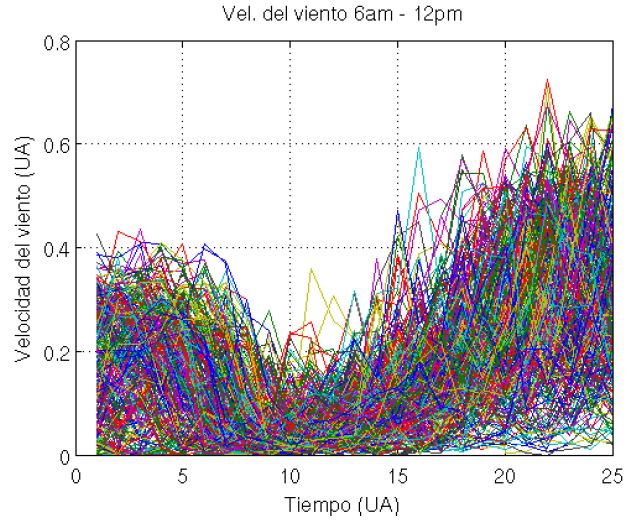
An Artificial Neural Network (RNA) was developed with capacity to make short-term climatic predictions, trained with data at intervals of 15 min for 454 days in a climatological station located in La Hechicera Mérida-Venezuela (1896 masl). For training and validation, were used simulated patterns that contain daily variations of radiance and temperature. Three test functions were chosen such as the Sine, Cosine and the Legendre Polynomials Pl(x). The (RNA) e.g, can predict the interval (0,1] using only as input the interval [-1,0] of the corresponding derivative P´l (x) of the polynomial. In the production phase with real data, it was found that the network is able to predict the temperature with approx. 5% error in the hourly range [12:15 to 06:15] pm, only with the temperature data in the range [6:00 to 12:00) am. Also, when predicting temperature from radiance (5%), radiance-radiance (16%). The use of (RNA) for the prediction of micro-climate in the short term is considered feasible, being able to extend its use to other localities, which could be useful for the development of disaster prevention plans, sowing periods, prediction of energy supply in wind and solar power stations.
Downloads
References
T. Carleton; S. Hsiang. Social and economic impacts of climate. Science, 353(6304):aad9837, 2016, Disponible: http://science.sciencemag.org/content/353/6304/aad9837.
A. Olmstead; P. Rhode. Responding to climatic challenges: lessons from us agricultural development. In The economics of climate change: Adaptations past and present, pages 169–194. University of Chicago Press, 2011.
T. Palmer. Predicting uncertainty in forecasts of weather and climate. Reports on Progress in Physics, 3(2):71, 2000.
United States Department of Energy (DOE), 2016.
P. Moonen; T. Defraeye; V. Dorer; B. Blocken; J. Carmeliet. Urban physics: effect of the micro-climate on comfort, health and energy demand. Frontiers of Architectural Research, 1(3):197–228, 2012.
T.F. Stocker. Ipcc (intergovernmental panel on climate change). climate change 2013: The physical science basics. Cambridge University Press:Cambridge, UK; New York, NY, USA, 2013.
R. Duda; P. Hart; D. Stork. Pattern classification. Wiley New York, 2 edition, 2001.
D. Lindley. Making decisions. Wiley, 2 edition, 1991.
S. Roy J. Traiteur; D. Callicutt; M. Smith. A short-term ensemble wind speed forecasting system for wind power applications. Journal of Applied Meteorology and Climatology, 51(10):1763–1774, 2012.
M. Vuckovic; K. Kiesel; A. Mahdavi. The extent and implications of the microclimatic conditions in the urban environment: A vienna case study. Sustainability, 9(2):177, 2017, Disponible: http://www.mdpi.com/2071-1050/9/2/177.
National Association of Regulatory Utility Commissioners (NARUC) National Wind Coordinating Collaborative (NWCC) and the Western Governors Association, 2007.
Ö. Dombaycı; M. Gölcü. Daily means ambient temperature prediction using artificial neural network method: A case study of turkey. Renewable Energy, 34(4):1158–1161, 2009.
A. Litta; S. Idicula; U. Mohanty. Artificial neural network model in prediction of meteorological parameters during premonsoon thunderstorms. International Journal of atmospheric sciences, 2013:1–14, 2013.
M. Behrang; E. Assareh; A. Ghanbarzadeh; A. Noghrehabadi. The potential of different artificial neural network (ann) techniques in daily global solar radiation modeling based on meteorological data. Solar Energy, 84(8):1468–1480, 2010.
I. Seginer. Some artificial neural network applications to greenhouse environmental control. Computers and Electronics in Agriculture, 18(2-3):167–186, 1997.
A. Kémajou; L. Mba; P.Meukam. Application of artificial neural network for predicting the indoor air temperature in modern building in humid region. British Journal of Applied Science & Technology, 2(1):23–34, 2012.
P. McSharry; S. Bouwman; G. Bloemhof. Probabilistic forecasts of the magnitude and timing of peak electricity demand. IEEE Transactions on Power Systems, 20(2):1166–1172, 2005.
A. Parisi; F. Parisi; D. Díaz. Modelos de algoritmos genéticos y redes neuronales en la predicción de índices bursátiles asiáticos. Cuadernos de economía, 43(128):251–284, 2006.
E. Trejos; P. Varela; J. Restrepo. Pronóstico del índice general de la bolsa de valores de Colombia usando redes neuronales. Scientia et technica, 1(41):129–134, 2009.
C. Bocanegra; H. Cybis; M. Jacques; M. Stumpf. Modelo de redes neuronales artificiales para determinar la velocidad en vías con fiscalización electrónica de la velocidad. In VI Congreso de Ingeniería del Transporte, 2004.
E. Rich; K. Knight. Artificial Intelligence. McGraw-Interamericana de España, 2 edition, 1994.
ADCON Telemetry. Products. adwave user manual, 2018, Disponible: http://www.adcon.com/products/sensors.
Downloads
Published
Issue
Section
License
The opinions expressed by the authors do not necessarily reflect the position of the publisher of the publication or of UCLA. The total or partial reproduction of the texts published here is authorized, as long as the complete source and the electronic address of this journal are cited.
The authors fully retain the rights to their works, giving the journal the right to be the first publication where the article is presented. The authors have the right to use their articles for any purpose as long as it is done for non-profit. Authors are recommended to disseminate their articles in the final version, after publication in this journal, in the electronic media of the institutions to which they are affiliated or personal digital media.