
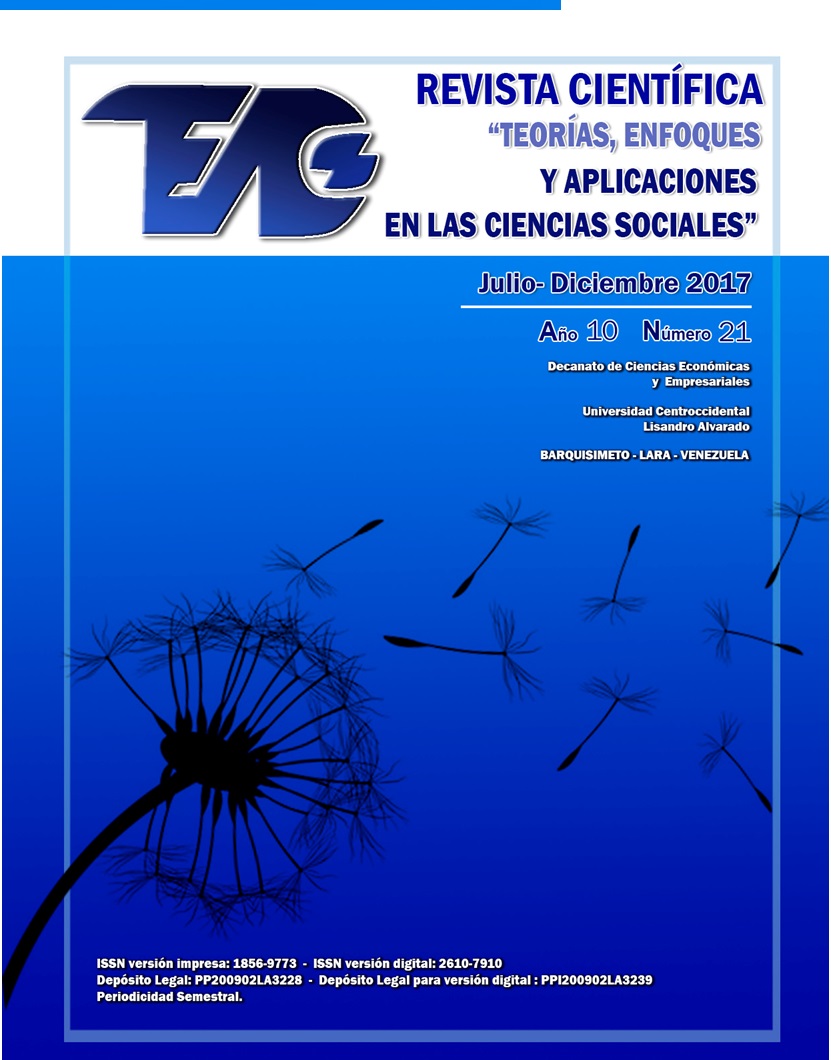
II International congress of performance evaluation, Valora 2017
Keywords:
performance, education, evaluation, planning, socioformationAbstract
The knowledge arises from processes that relate experiences and information that is acquired through methodological and daily information systems, which impacts on creative ways of interpreting realities through cognitive processes, which involve a change in the way of being of people to be in society, socioformation provides methods that involve using students' experiences, modifying the dynamics of learning, achieving an understanding of a more diffuse reality, which globalization is the main protagonist; the event of the II International Congress of Evaluation of Performance Values 2017, held on October 6 and 7, in a virtual way, as an objective, research and dissemination proposals were promoted in the educational field, the experts propose to develop an evaluation from a socioformative concept, which impacts on the design of instruments, validation, evaluation, application of tests, generate systemic processes on the evaluation of learning; researchers from educational institutions and service providers promote methodologies that respond to these changes and impact the teacher and student for real educational efficiency; plans, programs, systems, theory, praxis, being, knowing how to live together are general elements that should be integrated into any educational process, presented in class plans that are promoters of sustainable training, especially that responds to the demands of the environment personnel, in the area of local population, as well as with an assimilation of response to the global process.
Downloads
Published
Issue
Section
License
Derechos del/de autor/es a partir del año de publicación
Esta obra está bajo la licencia:
Creative Commons Reconocimiento-NoComercial-CompartirIgual 4.0 Internacional (CC BY-NC-SA 4.0)
Las opiniones expresadas por los autores no necesariamente reflejan la postura del editor de la publicación ni de la UCLA. Se autoriza la reproducción total o parcial de los textos aquí publicados, siempre y cuando se cite la fuente completa y la dirección electrónica de esta revista. Los autores(as) tienen el derecho de utilizar sus artículos para cualquier propósito siempre y cuando se realice sin fines de lucro. Los autores(as) pueden publicar en internet o cualquier otro medio la versión final aprobada de su trabajo, luego que esta ha sido publicada en esta revista.